BHORGIRI TO BHIMASHANKAR TREK - A serene journey through gurgling waterfalls!!!
Bhorgiri is a small village about 90 kms from Pune. From there a trail goes towards Bhimashankar Temple - a gentle walk through woods for about 6 kms. The trek goes through green meadows, misty mountains, clouds, thick evergreen forests (of the Bhimashankar Wildlife Sanctuary) and the best part is hundreds of small and large waterfalls gurgling through the mountains - all of them joining the Bhima river!!
TREK INFORMATION – This trek can be comfortably completed in one day. Trek starts from Bhorgiri and ends at Bhimashankar Temple in the wildlife sanctuary. Bhorgiri is a small village near Khed(Rajgurunagar) in Pune district. Bhorgiri has a very small fort with some caves and water tanks. Route to Bhorgiri - Pune Rajgurunagar-Vada-Tokavde-Bhorgiri that makes around 90 kms from Pune. One has to take the Pune - Nashik Highway and take left turn from Khed-Rajgurunagar. From here the route goes alongside the Chaskaman Dam and its backwaters.
Bhimashankar is one of twelve Jyotirlingas scattered throughout India. It is the place where Lord Shiva killed the Asura Bhima as he was troubling three lokas(worlds). After the battle Shiva was tired and through his sweat the river Bhima originated. Shiva manifested in form of the bhimashankar jyotirlingam. The temple is hundreds of years old and it is said that Sant Dnyaneshwar (13th century) visited it.
There are enough hotels available at Bhimashankar and eating is not to be worried about. River Bhima, tributary of Krishna, originates here. On the trek route is Gupt Bhimashankar - a place in forests which is one of the places where it supposedly originates.
The best part of staying in India is that here nature and spirituality are closely intertwined - so closely that at times one cannot separate it. In India trees, animals, rivers, mountains, etc are worshipped. It is not without reasons. Though there are many other significance attached to it; one of them is respecting Mother Nature - we do not destroy something which is sacred! But in these days traditions are carried without giving any thought to it. Take example of rivers - we revere and worship rivers. That means we have to keep rivers clean and do not pollute or throw waste in it. But this deep meaning is left behind and people just offer flowers and other things to the river. In older times rivers used to be so pure one can directly drink water from it. Imagine doing it now in any of our rivers!!
It is not a coincidence that our temples are located in such beautiful locations. We experienced it in our journey to Bhimashankar. The route goes through the most beautiful views and that makes us go deep within ourselves. This trek was like a meditative journey - just like meditation calm's one mind it too did so. The gurgling sound of waterfalls making their way over and through rocks and the chirping sound of birds is meditation for ears. The relaxing green colour (in nature) is like meditation for eyes. The fresh mountain air is good for the nose. This trek has it all!!
We were total 6 friends. We made our journey on 19th July 2015 on two wheeler bikes. We started early in morning. We had our Nashta on the way. At Khed we took left turn for Bhorgiri. Sometime after that we reached the Chaskaman dam. As the rains were not sufficient it contained less water than every year. But still it was beautiful. After the dam the scenery was awesome. Everywhere we could see mountains dressed in green; rather various shades of green – grass a faint green, trees more darker and the rice fields lush green. The rice fields shine golden when sunrays fall upon them. It was sowing season. Rice transplantation in the fields was going on and everywhere we could see farmers planting rice saplings in their fields. Really a back-breaking work.
 Buffaloes along with baglas creating a nice contrast.

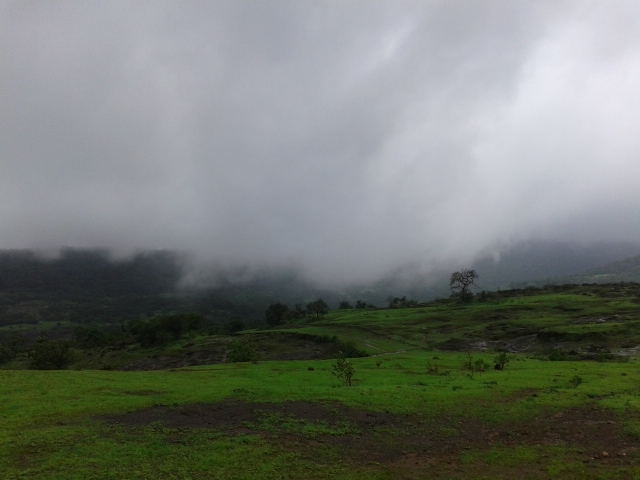
We reached Bhorgiri village; on our right side we could see Bhorgiri fort on a small hill. We decided to do Bhimashankar first. We parked our vehicles and after asking for direction started our trek. It was very gentle and broad track. And more than half the route doesn’t go through forests until the last stretch. But there are forests on all other sides. The chirping sounds and whistles of birds could be heard everywhere. Fog and clouds were floating everywhere. I couldn’t differentiate between fog and cloud. After some time we reached a plateau with green pasture. The greenery there was feast for eyes!!


 A crab posing for photo! YO!!!
 Another bright red coloured crab! Sahyadri has very rich variety of flora and fauna. We also got to see white coloured earthworm!
But the best part of this trek is innumerous waterfalls and stream everywhere. Waterfalls big and small, some gentle and some steep jumping across cliffs, some making a very soft noise while some gurgling merrily. The sound of waterfall is the best music to ears! Throughout the track, we were surrounded by at least one or two waterfalls or streams. One has to just pose besides a waterfall and click as much photos as desired. On the way there are two three streams which are to be crossed. Through the rock is slippery they are not dangerous. It is fun dipping legs in such cold relaxing waters.


I think the clouds are the best acrobats in the world. Performing different feats mid-air – changing shapes, going up, sliding down over mountains, floating on wind and what not! Sometimes a cloud is split into more clouds while sometimes two clouds merge to become One! And all these we get to see very closely in this trek! Wonderful!!
The trail suddenly enters in the forest. Tall trees everywhere. A dense forest where it is darker even in broad daylight. Spotless – there was no spot left unoccupied by trees. Even the forest floor was taken by various creepers, plants, grass. We couldn’t spot a shekru – giant squirrel – the state animal of Maharashtra. This route takes us to the backside of the Temple; on the opposite side of the conventional entry. As we near the temple sound, land, water pollution increases. Carry bags are thrown everywhere. The calm of forest is broken by visitors.
 The Bhimashankar temple is beautiful – made of black stone (kala pashan). It was engulfed in fog.
As there was big line we didn’t take darshan. We had our meal in one of the hotels outside the temple. Then we started our return journey on same path. We took the diversion towards gupt Bhima – a place in forests which is considered as one of the origins of the Bhima. It is at base of waterfall – a small Shivlinga and Nandi made in stone were placed below waterfall. It was getting continuous Mastakabhishek of water coming from the waterfall. Devotees had offered some flowers here. Nature+Spirituality! Beautiful!!
 Mysterious Forest!
We returned on our initial track and continued descending towards Bhorgiri. On our return journey the fog was getting denser. In the forest even the rocks, trees, stones were covered with moss (sheval) ; added to it the fog created a very mysterious, enchanting environment.
We returned in the Bhorgiri village. Although we had time we skipped the Bhorgiri fort as some of us had work in Pune. We started our return journey after a wonderful trek.
Bhorgiri is a small village about 90 kms from Pune. From there a trail goes towards Bhimashankar Temple - a gentle walk through woods for about 6 kms. The trek goes through green meadows, misty mountains, clouds, thick evergreen forests (of the Bhimashankar Wildlife Sanctuary) and the best part is hundreds of small and large waterfalls gurgling through the mountains - all of them joining the Bhima river!!
TREK INFORMATION – This trek can be comfortably completed in one day. Trek starts from Bhorgiri and ends at Bhimashankar Temple in the wildlife sanctuary. Bhorgiri is a small village near Khed(Rajgurunagar) in Pune district. Bhorgiri has a very small fort with some caves and water tanks. Route to Bhorgiri - Pune Rajgurunagar-Vada-Tokavde-Bhorgiri that makes around 90 kms from Pune. One has to take the Pune - Nashik Highway and take left turn from Khed-Rajgurunagar. From here the route goes alongside the Chaskaman Dam and its backwaters.
Bhimashankar is one of twelve Jyotirlingas scattered throughout India. It is the place where Lord Shiva killed the Asura Bhima as he was troubling three lokas(worlds). After the battle Shiva was tired and through his sweat the river Bhima originated. Shiva manifested in form of the bhimashankar jyotirlingam. The temple is hundreds of years old and it is said that Sant Dnyaneshwar (13th century) visited it.
There are enough hotels available at Bhimashankar and eating is not to be worried about. River Bhima, tributary of Krishna, originates here. On the trek route is Gupt Bhimashankar - a place in forests which is one of the places where it supposedly originates.
The best part of staying in India is that here nature and spirituality are closely intertwined - so closely that at times one cannot separate it. In India trees, animals, rivers, mountains, etc are worshipped. It is not without reasons. Though there are many other significance attached to it; one of them is respecting Mother Nature - we do not destroy something which is sacred! But in these days traditions are carried without giving any thought to it. Take example of rivers - we revere and worship rivers. That means we have to keep rivers clean and do not pollute or throw waste in it. But this deep meaning is left behind and people just offer flowers and other things to the river. In older times rivers used to be so pure one can directly drink water from it. Imagine doing it now in any of our rivers!!
It is not a coincidence that our temples are located in such beautiful locations. We experienced it in our journey to Bhimashankar. The route goes through the most beautiful views and that makes us go deep within ourselves. This trek was like a meditative journey - just like meditation calm's one mind it too did so. The gurgling sound of waterfalls making their way over and through rocks and the chirping sound of birds is meditation for ears. The relaxing green colour (in nature) is like meditation for eyes. The fresh mountain air is good for the nose. This trek has it all!!
We were total 6 friends. We made our journey on 19th July 2015 on two wheeler bikes. We started early in morning. We had our Nashta on the way. At Khed we took left turn for Bhorgiri. Sometime after that we reached the Chaskaman dam. As the rains were not sufficient it contained less water than every year. But still it was beautiful. After the dam the scenery was awesome. Everywhere we could see mountains dressed in green; rather various shades of green – grass a faint green, trees more darker and the rice fields lush green. The rice fields shine golden when sunrays fall upon them. It was sowing season. Rice transplantation in the fields was going on and everywhere we could see farmers planting rice saplings in their fields. Really a back-breaking work.


Bhorgiri fort is the hill in centre and on left is bhorgiri village.
We reached Bhorgiri village; on our right side we could see Bhorgiri fort on a small hill. We decided to do Bhimashankar first. We parked our vehicles and after asking for direction started our trek. It was very gentle and broad track. And more than half the route doesn’t go through forests until the last stretch. But there are forests on all other sides. The chirping sounds and whistles of birds could be heard everywhere. Fog and clouds were floating everywhere. I couldn’t differentiate between fog and cloud. After some time we reached a plateau with green pasture. The greenery there was feast for eyes!!

The trail going towards Bhimashankar!

Greeeeeennn Plateau!!!

A log of wood.


But the best part of this trek is innumerous waterfalls and stream everywhere. Waterfalls big and small, some gentle and some steep jumping across cliffs, some making a very soft noise while some gurgling merrily. The sound of waterfall is the best music to ears! Throughout the track, we were surrounded by at least one or two waterfalls or streams. One has to just pose besides a waterfall and click as much photos as desired. On the way there are two three streams which are to be crossed. Through the rock is slippery they are not dangerous. It is fun dipping legs in such cold relaxing waters.

A stream on the way.

Another plateau.
The trail suddenly enters in the forest. Tall trees everywhere. A dense forest where it is darker even in broad daylight. Spotless – there was no spot left unoccupied by trees. Even the forest floor was taken by various creepers, plants, grass. We couldn’t spot a shekru – giant squirrel – the state animal of Maharashtra. This route takes us to the backside of the Temple; on the opposite side of the conventional entry. As we near the temple sound, land, water pollution increases. Carry bags are thrown everywhere. The calm of forest is broken by visitors.

As there was big line we didn’t take darshan. We had our meal in one of the hotels outside the temple. Then we started our return journey on same path. We took the diversion towards gupt Bhima – a place in forests which is considered as one of the origins of the Bhima. It is at base of waterfall – a small Shivlinga and Nandi made in stone were placed below waterfall. It was getting continuous Mastakabhishek of water coming from the waterfall. Devotees had offered some flowers here. Nature+Spirituality! Beautiful!!

We returned on our initial track and continued descending towards Bhorgiri. On our return journey the fog was getting denser. In the forest even the rocks, trees, stones were covered with moss (sheval) ; added to it the fog created a very mysterious, enchanting environment.
We returned in the Bhorgiri village. Although we had time we skipped the Bhorgiri fort as some of us had work in Pune. We started our return journey after a wonderful trek.
